Recently I saw a video, recommended by a friend, which talks about the proof to a simple question in probability theory: what's the probability of cutting a stick into three pieces and that they form a valid triangle? The topic itself was interesting and well-explained in the video, but the author referred to a theorem that's very interesting:
Viviani's Theorem
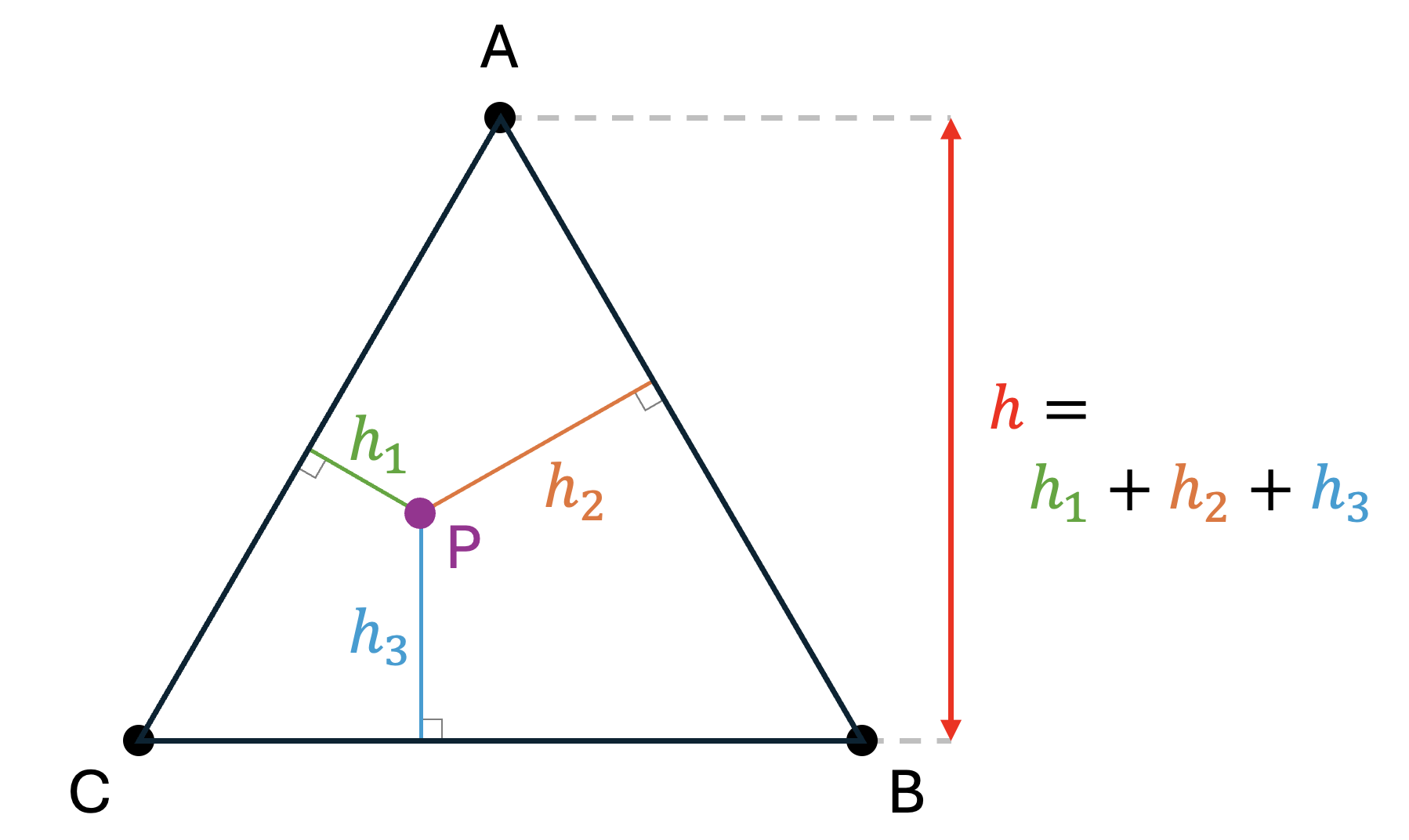
Given an equilateral triangle of side length \(s\), we choose point \(P\) inside, and draw the distance between \(P\) and the 3 sides of the triangle (\(h_1,h_2,h_3\)), the sum of the distances is always the height \(h\) of the triangle.
Visually:
The proof to it is pretty simple. You have a hint in the next paragraph and what follows is the complete proof.
Hint
There are three triangles inside, each with a formula whose sum can be easily simplified.
Proof
First we divide the triangle \(\widehat{ABC}\) into 3 little triangles \(\widehat{ABP}\), \(\widehat{APC}\), and \(\widehat{PBC}\).
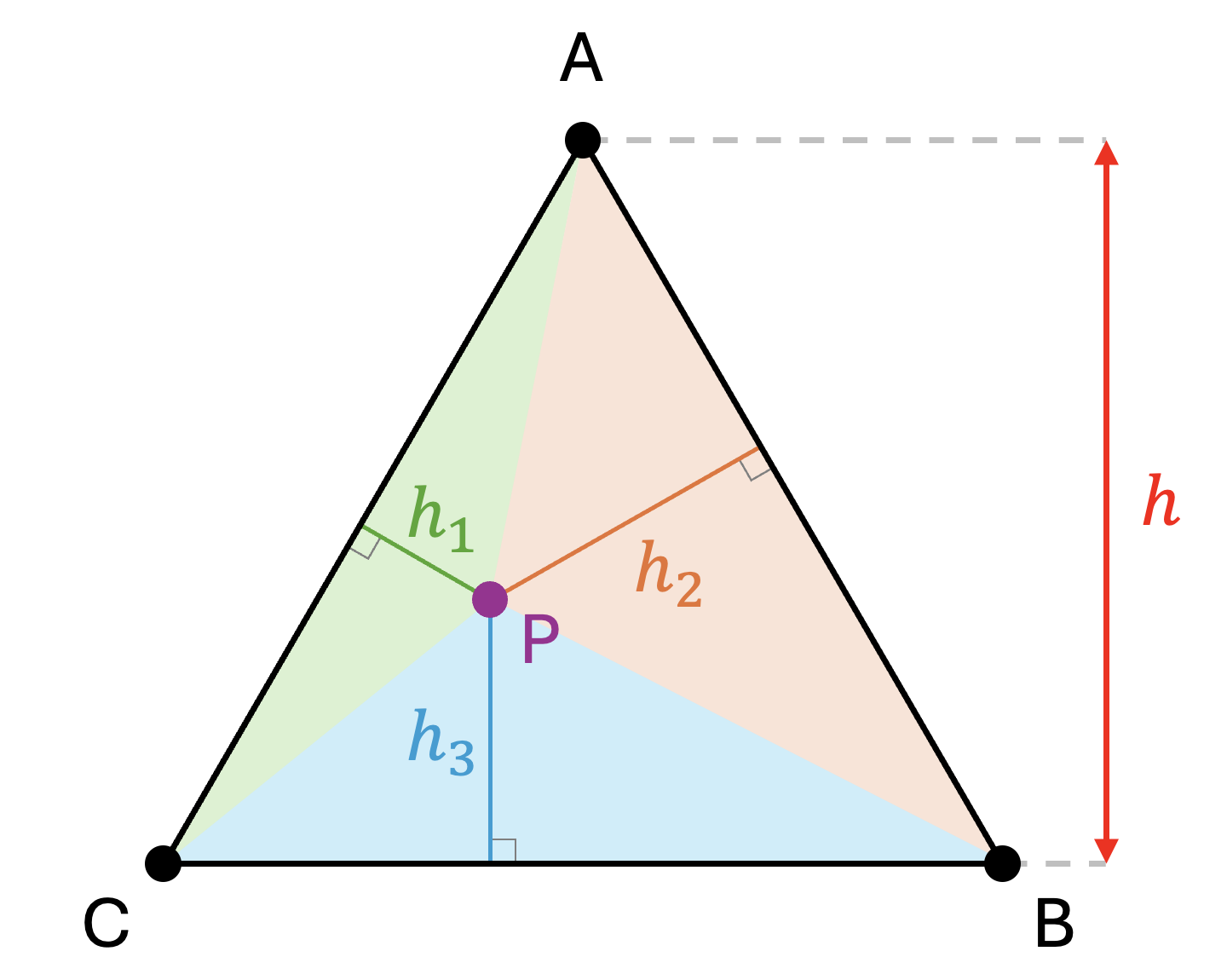
The area of each of the small triangles is \(\frac{\text{Base}\times\text{Height}}{2}\). Since the \(\text{Base}\) of all three triangles is the same side-length \(s\), basically:
\[
\frac{s\times h}{2}=\frac{s\times h_1}{2}+\frac{s\times h_2}{2}+\frac{s\times h_3}{2}
\]
Simplifying:
$$ h=h_1 + h_2 + h_3 $$ Which is what we wanted to proof.
Now what?
For a square (and even a rectangle), it's not the height anymore, but it is obvious that their sum preserve some sort of a constant:
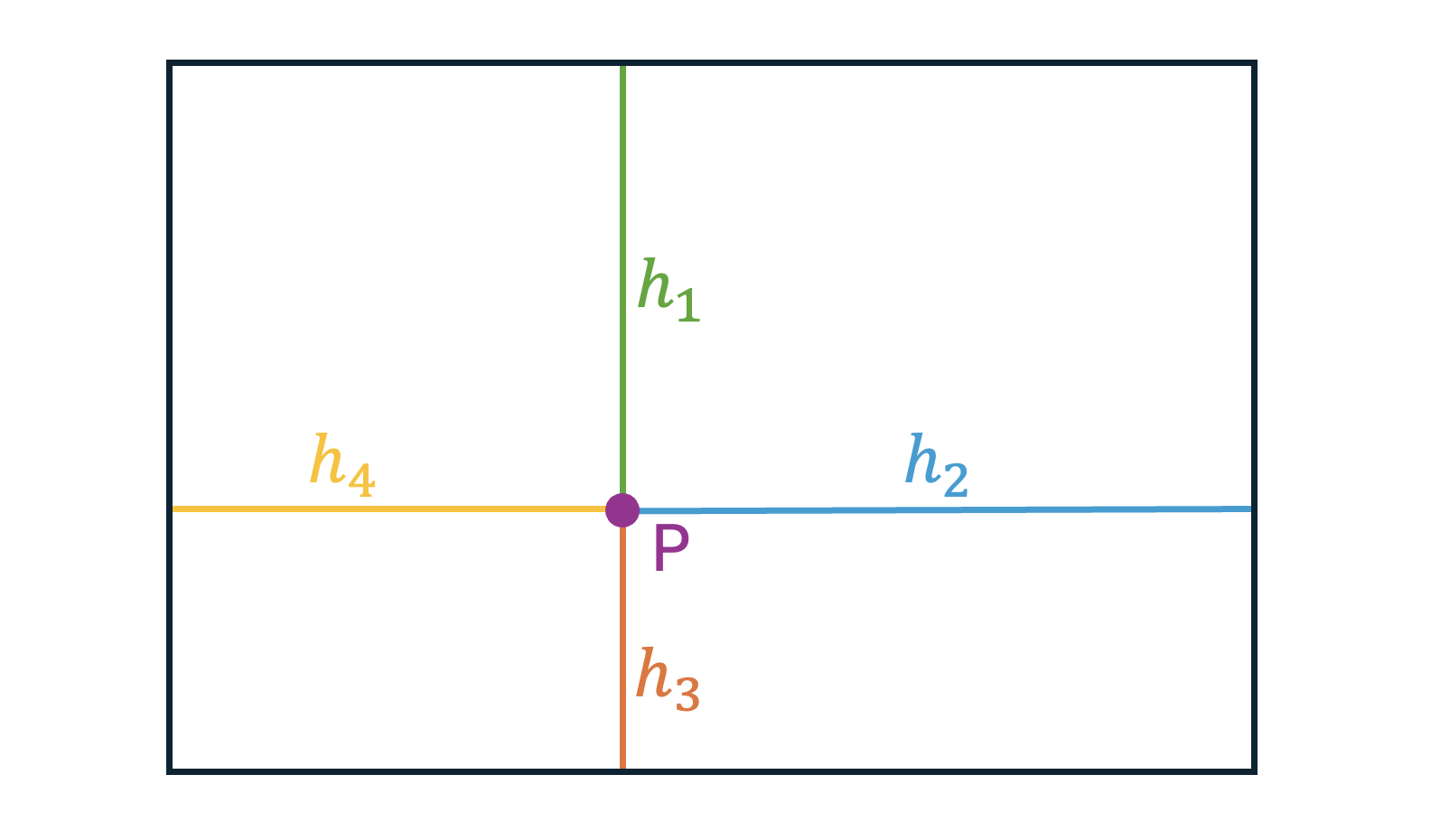
Which is equivalent to:
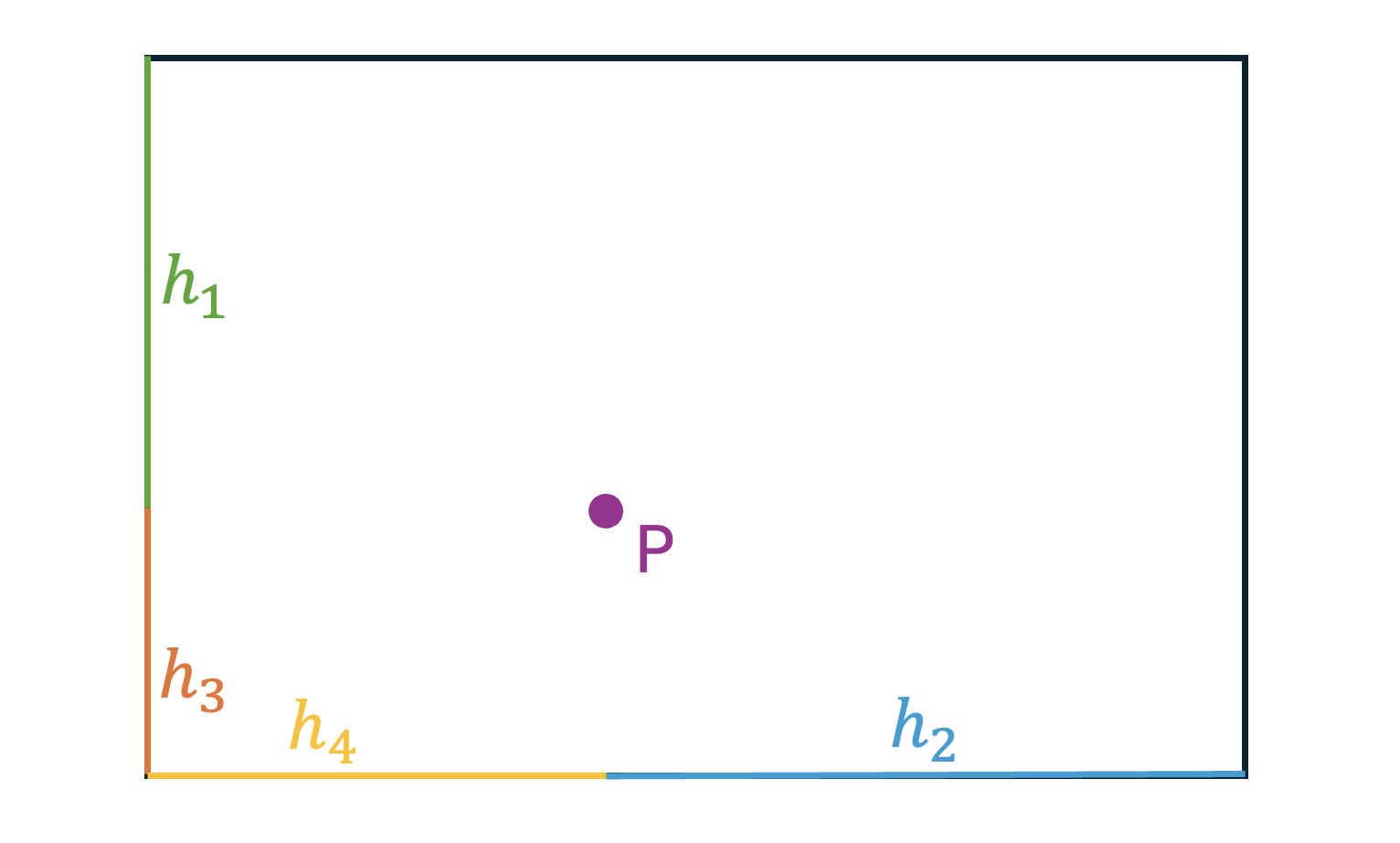
Half of the perimeter.
What about equilateral shapes of more sides? (Regular) pentagons, hexagons, heptagons, octagons, etc. What is the constant their "sum of heights to \(P\)" that's preserved? Is it even preserved?
This is what I thought after seeing Viviani's Theorem. Let's put our hands to it.
Generalization of Viviani's Theorem (for regular polygons)
We have two questions to tackle, and none of them is difficult, at all! What a thrilling piece of news, innit? Let's start easy:
Preservation of sum
As intelligent as my reader – you – are, my dear reader might think of "can we apply the same procedure as we did for triangles?". The answer is YES.
Consider that, given \(P\) inside our polygon, for each side we can draw a triangle connecting the side and the \(P\). So we have as many triangles as the number of sides. For a pentagon we would have 5 triangles:
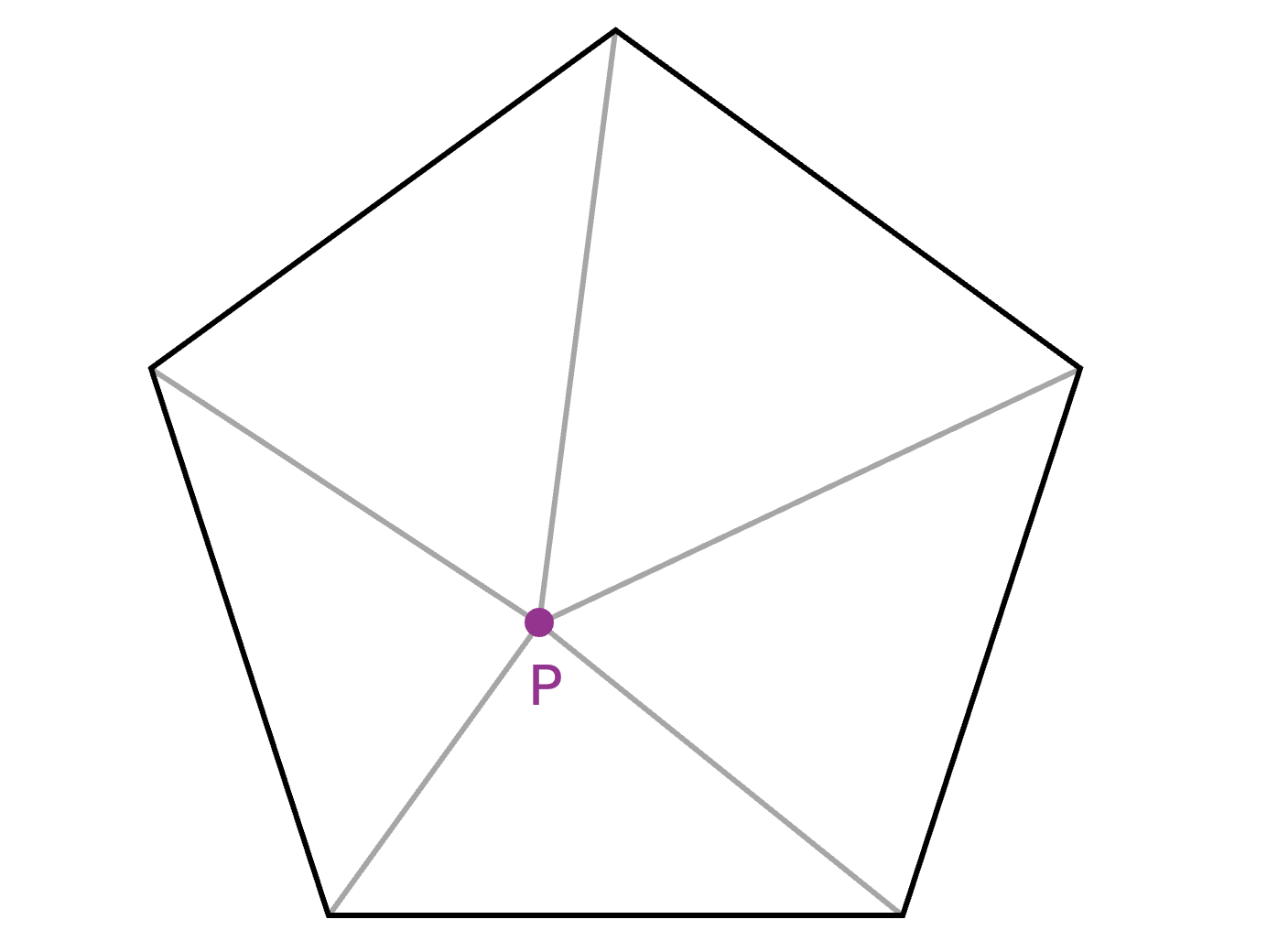
Since for whatever the \(P\) is, the \(\sum _{i=1} ^5 \text{Area of triangle }i\) is constant, and we know for sure the formula for \(\text{Area of triangle }i\) which is simply \(\frac{s\times h_i}{2}\), we know that
$$ \frac{2}{s}\times A_{pentagon}=\sum _{i=1} ^5 h_i $$ In order to calculate the area of a pentagon, we simply put \(P\) at the center and, by what we all learnt in secondary school, calculate the area of one triangle and multiply that by \(\#sides\).
The value it preserves
Now this is trivial. We just want to know, what is the area of a regular polygon of \(\#sides\) each with a length of \(s\)?
Let \(n\) be the number of sides, and \(s\) the length of each side.
Basic trigonometry:
\[
A_{triangle} = \frac{ \text{Base} \times \text{Height} } {2}=\frac{ s \times h } {2}
\]
Let \(\alpha\) be half the angle of a small triangle, it holds: $$ \tan\alpha =\frac{s}{2h} \Leftrightarrow h=\frac{s}{2\tan\alpha} $$ The value of \(\alpha\) is, the whole rotation \(2\pi\) divided by number of sides \(n\) and divided by \(2\), so \(\alpha=\frac{2\pi}{2n}=\frac{\pi}{n}\).
Therefore:
\[
A_{triangle} = \frac{sh}{2} = s\frac{\frac{s}{2\tan\alpha}}{2}=\frac{s^2}{4\tan\alpha}=\frac{s^2}{4\tan\frac{\pi}{n}}
\]
Let's plug it in the original equation, and we have that:
\[
\frac{sn}{2\tan\frac{\pi}{n}}=\sum _{i=1} ^n h_i
\]
An equation that depends on
-
\(n\): the number of sides;
-
\(s\): the length of each side.
We can check that it works for equilateral triangles (note that \(cos(\frac{\pi}{3})=\frac{1}{2}\)):
\[
h_{Triangle}=s\times \sin(\frac{\pi}{3}) \stackrel{}{=} \frac{2s\sin^2{(\pi/3)}}{2\sin{(\pi/3)}} \stackrel{(1)}{=} \frac{2s(1-\cos^2{(\pi/3)})}{\frac{\sin{(\pi/3)}}{\cos{(\pi/3)}}} \stackrel{(2)}{=}
\]
\[
\stackrel{(2)}{=} \frac{2s(\frac{3}{4})}{\tan{(\pi/3)}} \stackrel{(3)}{=} \frac{s2}{2\tan{(\pi/3)}}=\frac{sn}{2\tan\frac{\pi}{n}}
\]
The steps are (little brackets above the \(=\) signs):
-
Here we used \(\sin^2{x}+\cos^2{x}=1\) and \(cos(\frac{\pi}{3})=\frac{1}{2}\).
-
Here we used \(\frac{\sin{x}}{\cos{x}}=\tan{x}\).
So we indeed shown that it is valid for \(n=3\).
Further thoughts
Q: can you do it for a random convex polygon?
Definition of "convex shape": Pick two points as you like in the shape, and draw a straight segment between them, all the points on the segment must be inside the shape.
For example, in 2D, a triangle is convex, a donut is not, and a circumference is convex.
This question is somewhat easy and recalls me an interesting theorem.
The answer is Yes, you can do the same "triangle area" for a random convex polygon, so the heights preserve
We have to suppose that no two edges overlap with each other.
Yes, you can do the same procedure for a random convex polygon. Since you can draw a straight line between any two points and all points of the line is contained, in particular, if you choose a point \(P\), and chose a side, let it be points \(QR\), for whatever point \(P_2 \in QR\), the line \(PP_2\) is completely contained in the shape, so in particular the whole triangle \(\widehat{PQR}\) is completely contained in the shape.
Choose an initial point \(P\) as you like in the shape, and compute the total area \(A\) formed by the triangles, then you know the heights of each side to another point \(Q\) satisfies the constant \(\frac{2A}{s}\).
Pick's Theorem
You might ask, how to easily compute the area of a polygon? A famous mathematician called Georg Alexander Pick in 1899 described an interesting result: draw your polygon on a plane where your vertices can only be of integer coordinates: (image from Wikipedia)
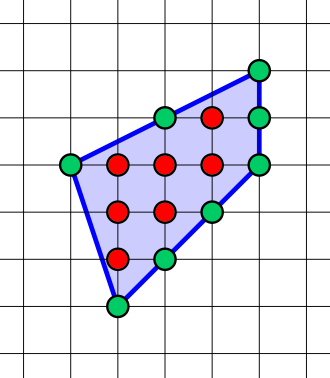
The formula describes the relationship between Area \(A\) (the blue area, \(A\)), the number of Boundary points \(b\) touching the integer coordinates (green points), and the number of Interior points \(i\) whose coordinate is integer (red points).
\[
A=i+\frac{b}{2}-1
\]
Here we have \(i=7\), \(b=8\), so the area \(A=7+\frac{8}{2}-1=10\).
This makes it easier to calculate the area of a polygon at first place.
Further question: can you extend it to rational \(\mathbb{Q}\) coordinate points? This is left to my dear reader.
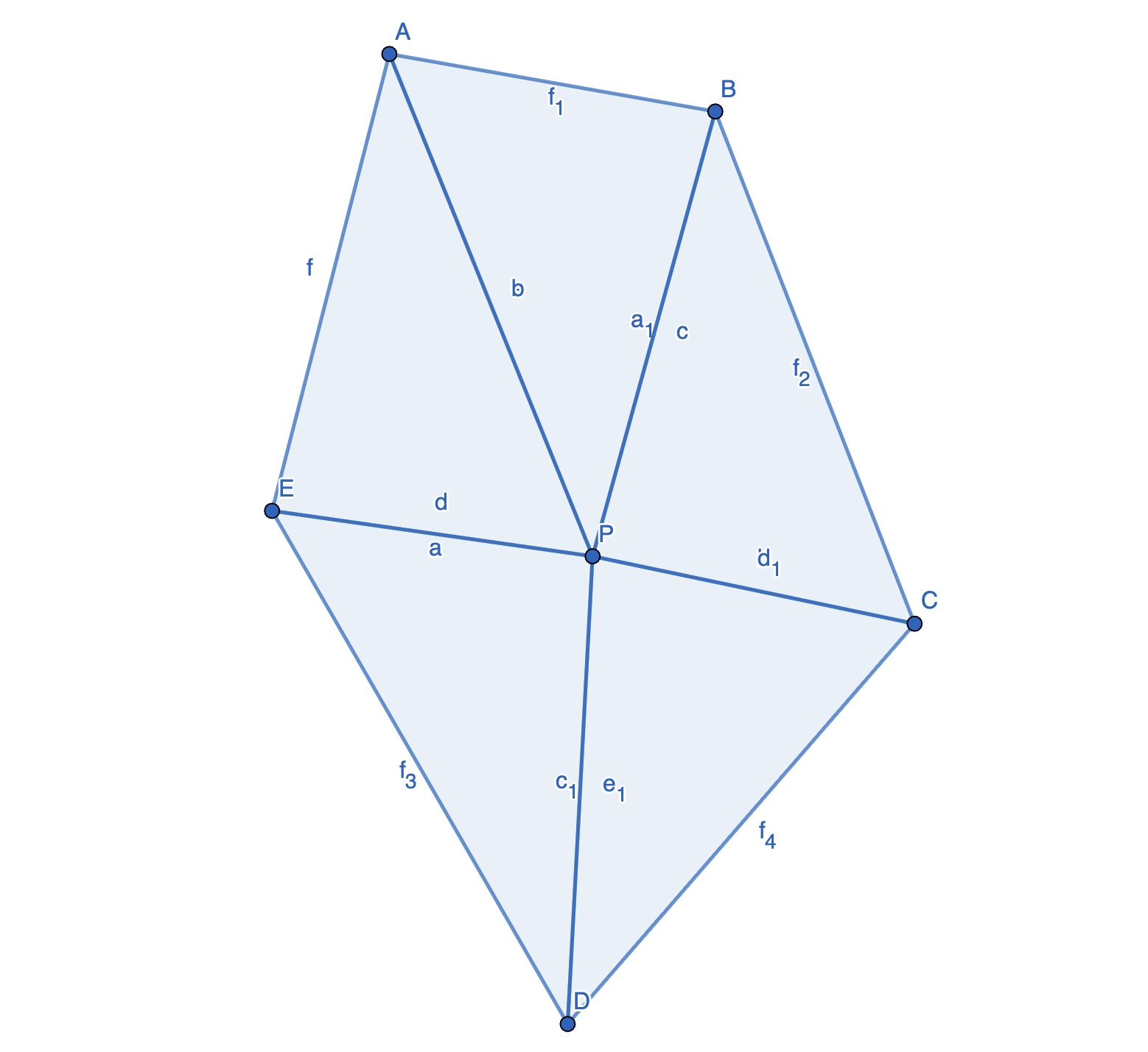
Q: given a random convex polygon, is there always a point \(P\) where the area of the triangles formed by a side and \(P\) are equal?
For example, for this pentagon, the \(P\) where the 5 triangles have the same area is:
Answer: No. Counterexample:
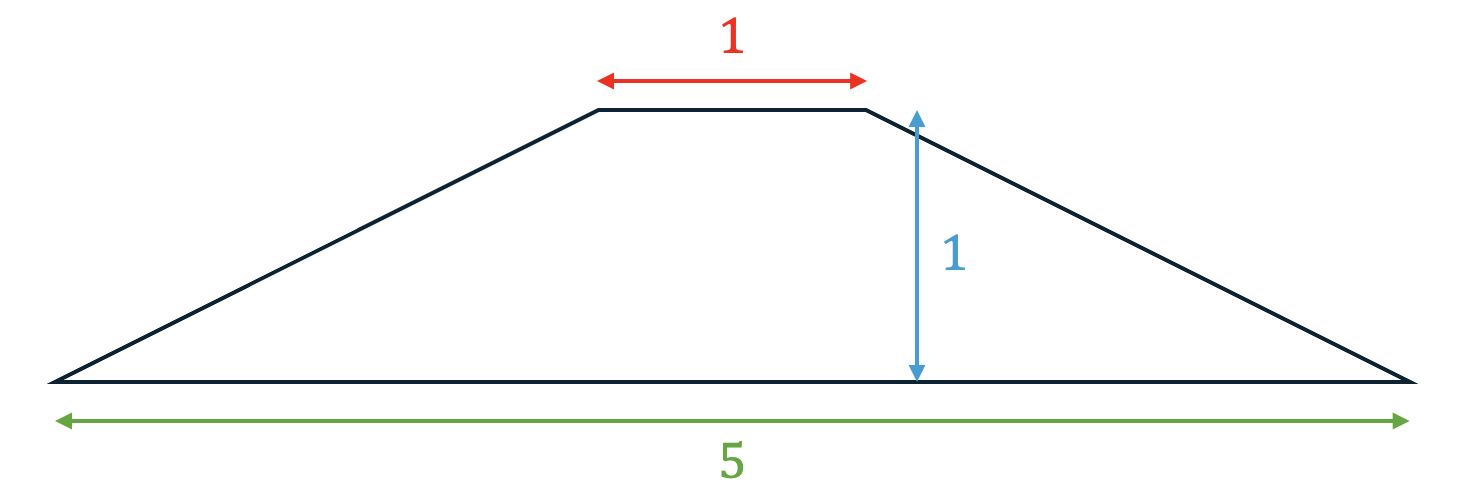
For a point \(P\), we draw triangles to \(P\) and we want the area of all four triangles be the same. This is a perfect trapezoid, the total area is \((5-1)\times1=4\). So, if there is a \(P\) such that the four triangles have the same area, the area of each should be \(1\).
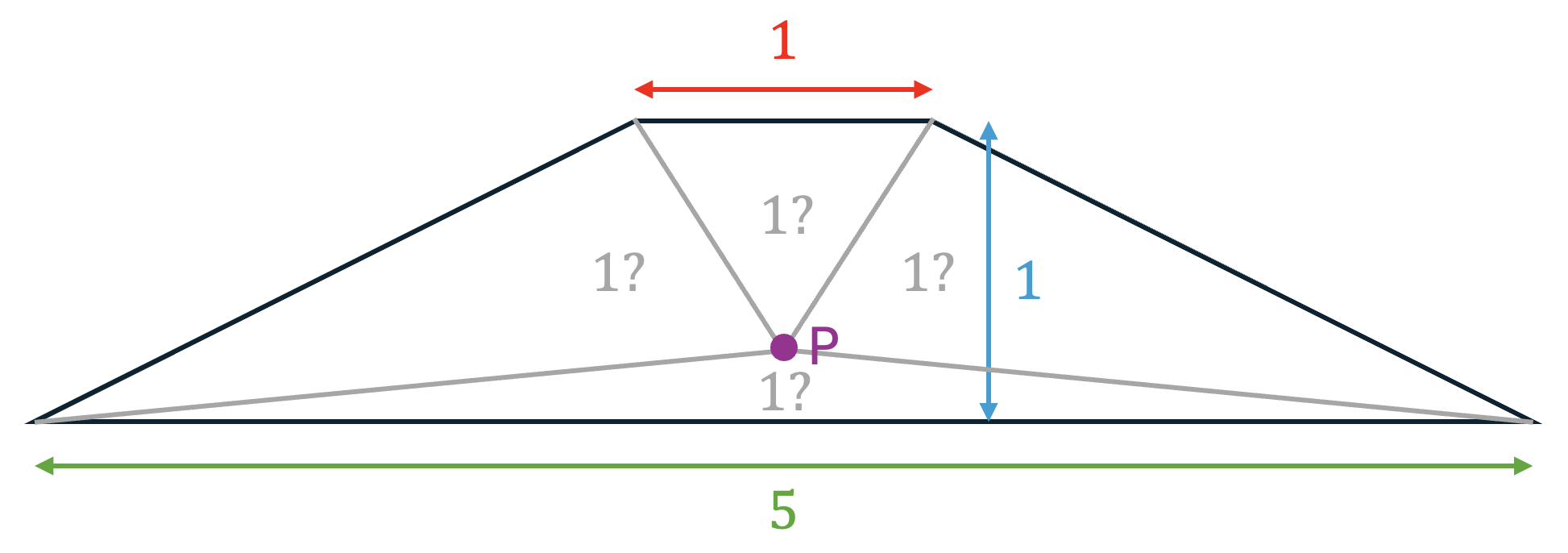
But it is impossible. The upper triangle can have at most an area of \(\frac{1}{2}\), because whenever the \(P\) is, its formula is \(\frac{\text{Base}\times\text{Height}}{2}\), the \(\text{Base}\) is always \(1\), the \(\text{Height}\) is simply "how far is \(P\)", which can move to whatever point in the trapezoid and the \(\text{Height}\) will never exceed \(1\), the height of the trapezoid. Now we have that \(A_{\text{upper triangle}} = \frac{\text{Base}\times\text{Height}}{2} \leq \frac{1\times1}{2}=\frac{1}{2}\), pretty far away form being \(1\).
Thank you for reading.
THE END
Latest
Subway Math September 2025 (proven)
Guide for your Markdown
This will lead you to a randomly selected post. (Reload the page for another shuffle)